
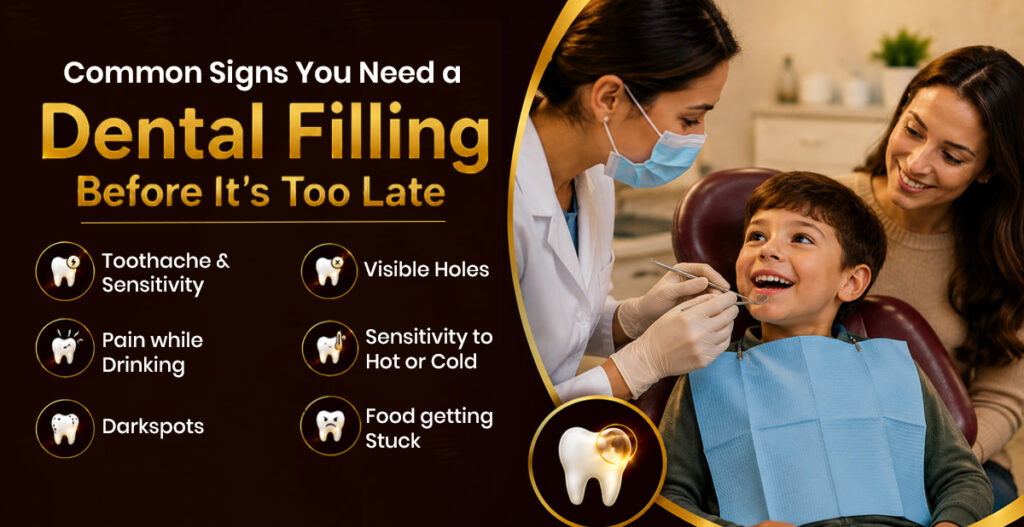
Common Signs You Need a Dental Filling — Don’t Ignore These Symptoms
Most people don’t visit their dentist until something hurts badly enough to disrupt their day. By that point, what could have been a straightforward dental filling has often progressed into something far more involved and far more expensive.
The uncomfortable truth about tooth decay is that it rarely announces itself loudly in the beginning. It whispers. A brief twinge when you sip something cold. A shadow on an X-ray. A tiny pit on a back molar you’ve never even noticed. These quiet signals are your teeth asking for help before the situation becomes urgent.
Understanding the early signs that you need a dental filling and acting on them promptly is one of the simplest, most effective things you can do for your long-term oral health. Here’s what to watch for.
What Is a Dental Filling and Why Does It Matter?
A dental filling is a tooth decay treatment that restores a damaged or decayed tooth to its normal shape, function, and integrity. When a cavity — a small hole caused by bacterial decay — forms in your tooth enamel, it doesn’t heal on its own. Left untreated, it deepens, spreads, and eventually reaches the sensitive inner layers of the tooth, causing pain, infection, and potentially tooth loss.
A filling stops that progression. The decayed portion is removed, the cavity is cleaned, and the space is filled with a material — composite resin, amalgam, ceramic, or glass ionomer — that seals and protects the tooth.
The earlier a filling is placed, the simpler, less invasive, and less costly the procedure. Waiting transforms a thirty-minute dental visit into a root canal, a crown, or an extraction.
7 Signs You May Need a Dental Filling
1. Tooth Sensitivity to Hot, Cold, or Sweet Foods
If you experience a sharp, brief twinge when you eat ice cream, drink hot chai, or bite into something sweet, pay attention. Sensitivity like this — especially when it lingers for more than a second or two — often signals that the protective enamel has been compromised, exposing the sensitive dentin underneath.
Not all sensitivity means a cavity. Worn enamel, gum recession, or grinding can also cause it. But persistent sensitivity in one specific tooth, particularly if it’s new, is worth a dental evaluation. Catching a cavity at the sensitivity stage, before it reaches the nerve, means a filling is usually all you need.
2. Visible Holes, Pits, or Dark Spots on Your Teeth
Sometimes you can see the problem directly. A dark spot, brown discolouration, or a small visible pit on the surface of a tooth is often a cavity in progress — or already established.
These spots appear most frequently on the chewing surfaces of back molars and in the spaces between teeth. They’re easy to miss on your own, which is why regular dental check-ups and X-rays matter. If you notice visible changes in the appearance of your teeth, don’t wait for pain to develop. By the time a cavity causes visible structural damage, the decay has already progressed significantly.
3. Toothache or Throbbing Pain
A toothache that comes and goes — or one that sets in when you bite down on food — is a serious signal. Pain means the decay has likely reached deeper layers of the tooth and may be approaching or already affecting the pulp (the innermost tissue containing nerves and blood vessels).
At this stage, a simple filling may still be possible if the decay hasn’t reached the nerve. But the window is narrowing. If the pain is persistent, throbbing, or wakes you at night, it may indicate that an infection has developed, requiring more extensive tooth decay treatment. See a dentist immediately.
4. Food Getting Stuck in the Same Spot Every Time
If you notice that food consistently gets caught in one particular area of your mouth — between two specific teeth, or in a groove on a molar — it may be because a cavity has created a physical gap or rough edge that traps food.
This is worth paying attention to not just as a potential decay indicator, but because trapped food accelerates further decay. Bacteria feed on food particles that remain between teeth. If you find yourself reaching for a toothpick after every meal for the same spot, mention it at your next dental visit.
5. A Rough, Chipped, or Uneven Tooth Surface
Run your tongue along your teeth. They should feel smooth and even. If a tooth feels rough, jagged, or noticeably different in texture than before — especially on a chewing surface — the enamel may have been compromised.
Teeth can chip slightly from injury or grinding, but enamel can also erode and roughen due to decay. Either way, an uneven surface creates more places for plaque to accumulate, accelerating the cavity risk. A filling can restore the tooth’s smooth contour and remove the rough edge that’s trapping bacteria.
6. A Lost or Damaged Old Filling
Dental fillings are not permanent. They wear down over time, especially with chewing forces, teeth grinding, and the natural expansion and contraction of the tooth from temperature changes. An old filling can crack, chip, loosen, or fall out entirely — leaving the underlying tooth vulnerable to fresh decay.
If you notice that an old filling feels different, appears cracked, or goes missing entirely, treat it as an urgent dental matter. The tooth underneath is no longer protected and can decay rapidly. Replacing a damaged filling promptly is far simpler than treating the decay that develops from leaving it exposed.
7. No Symptoms at All — But You Haven’t Seen a Dentist in Over a Year
This may be the most important point of all. Early-stage cavities frequently cause no pain, no sensitivity, and no visible signs. They are diagnosed on dental X-rays and during clinical examinations — not by waiting for discomfort to develop.
Cavity prevention is not just about brushing and flossing, though both matter enormously. It is also about regular professional check-ups that catch decay in its earliest, most reversible stages when remineralization or a small filling is all that’s needed. Visiting your dentist every six months is not excessive caution; it is the single most effective thing you can do to avoid larger dental procedures down the line.
When a Filling Is No Longer Enough
Understanding the signs that require a filling also means understanding when a filling is no longer sufficient. If the decay has reached the pulp of the tooth, a root canal treatment becomes necessary before a crown can be placed. If the tooth structure is too compromised to support a filling, a crown may be needed. And in severe cases where the tooth cannot be saved, extraction followed by an implant or bridge may be the recommended path.
None of these outcomes are inevitable. They are, in most cases, the result of delayed treatment. What begins as a cavity that a filling could have resolved in thirty minutes becomes a multi-visit, multi-procedure process because the warning signs were missed or ignored.
A Note on Cavity Prevention
The best tooth decay treatment is the one you never need. Brushing twice daily with a fluoride toothpaste, flossing every night, limiting sugary and acidic foods, drinking adequate water, and attending regular dental check-ups are the foundations of cavity prevention.
But even with diligent home care, decay can still develop, particularly in hard-to-reach areas between teeth and in the deep grooves of molars. Professional cleaning removes the calcified plaque (tartar) that brushing cannot, and regular X-rays catch what the eye cannot see.
Your teeth are meant to last a lifetime. A dental filling, placed at the right time, is one of the simplest ways to make sure they do.
Experiencing any of these signs? Don’t wait for the pain to worsen. Book a dental examination today and protect your smile before a small cavity becomes a bigger problem.