
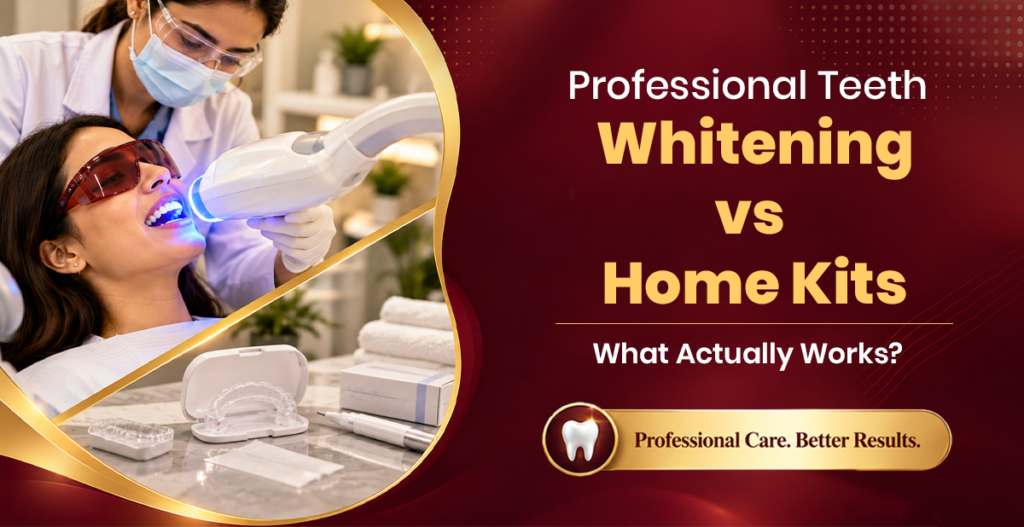
Let’s be honest about how most people end up researching this topic. You saw someone’s before-and-after on Instagram. Or you walked past the whitening section at the chemist, picked up a box, looked at the price, put it back down, picked it up again. Or a friend mentioned they got their teeth done at the dentist and it cost less than you expected.
Whatever brought you here, the question underneath is usually the same one. Is the dentist actually worth it, or can I get a similar result from something that costs forty dollars at the pharmacy?
The real answer is: it depends. And not in the vague, unhelpful way that phrase usually means. It depends on what type of staining you have, how dramatic a result you’re after, and whether you have the patience to use a home product consistently for weeks. Those things genuinely change the calculation.
Around 22% of Australian adults have had their teeth whitened. Only 1 in 3 of them went to a dentist for it. The rest used some form of home product, and nearly 4 in 10 of those bought the kit online. Some of those people got results they were happy with. Others got gum damage from unregulated products that had no business being sold in the first place. That spread of outcomes is exactly why this comparison is worth doing properly.
This is what teeth whitening Canberra patients actually need to know before spending money on anything.
The One Thing That Explains Most of the Difference
Every whitening product, from the $30 strips at the pharmacy to a professional in-chair treatment, works the same way at a chemical level. A bleaching agent, hydrogen peroxide or carbamide peroxide, gets into the enamel and breaks apart the compounds causing the discolouration. The tooth looks lighter because the stain molecules are gone.
The difference between a home kit and a professional treatment isn’t the mechanism. It’s the concentration of the bleaching agent, and how big that gap is will probably surprise you.
Under Australian law, products sold directly to consumers are capped at 6% hydrogen peroxide. That’s the legal limit under the Poisons Standard, and it applies to everything on the pharmacy shelf regardless of how confidently the packaging describes the results.
Registered dental professionals can legally use concentrations up to 38% hydrogen peroxide for in-chair whitening. Dentist-prescribed take-home trays sit somewhere in the middle, usually 10 to 22% carbamide peroxide, which is still several times stronger than anything you can buy without a prescription.
That’s not a minor difference. That concentration gap is the main reason a single appointment can do what weeks of pharmacy strips sometimes can’t.
So What Actually Happens at a Professional Whitening Appointment?
It’s worth walking through this because a lot of patients picture something more complicated than it is.
First, your dentist checks that whitening is actually appropriate for you. This step matters more than people realise. Active gum disease needs to be treated first. Crowns and veneers on front teeth won’t whiten, because the bleaching agent only works on natural enamel. And certain types of deep, internal discolouration respond to whitening differently than surface staining does. A two-minute look at your teeth answers most of these questions before anything else happens.
Then the procedure itself. A protective barrier goes over the gum tissue and the soft tissue inside the mouth before any gel is applied. This is the part DIY kits skip, and it’s what makes high-concentration gel safe to use in the first place. Once the gums are protected, the whitening gel goes on the teeth and stays in place for one or more cycles depending on the system being used.
The whole thing takes about 60 to 90 minutes. Most people leave with teeth 5 to 8 shades lighter than when they arrived.
Sensitivity is real and it’s worth saying so upfront. Somewhere between 60 and 75% of patients feel temperature sensitivity in the day or two after treatment. It’s temporary. It happens because the whitening process temporarily opens the pores of the enamel, which makes the nerve inside more reactive. A sensitivity toothpaste in the days before your appointment helps, and your dentist will give you specific advice about what to avoid eating and drinking while it settles.
Vogue Family Dental currently offers professional teeth whitening for $249. That’s well below what in-chair whitening costs at most clinics nationally, which removes the cost argument that sends a lot of people to the pharmacy shelf instead.
What About Dentist Take-Home Trays?
This option tends to get overlooked in the professional-versus-home-kit debate, which is frustrating because it’s genuinely useful.
Custom-fitted take-home trays are made from an impression of your specific teeth at the dental practice. You fill them with a professional-strength whitening gel at home and wear them for a set number of hours each day over one to two weeks. The gel is stronger than anything over-the-counter, but because the trays fit precisely, it stays on the teeth where it needs to be rather than pooling onto gum tissue.
That precise fit is actually the critical detail. The irritation people commonly experience with pharmacy kit trays almost always comes from gel contact with the gums, not the whitening gel itself. When the tray fits properly, the gel doesn’t get where it shouldn’t.
Results with take-home trays are gradual rather than immediate, but they’re consistent and you can control the pace. Some patients prefer this. Others do both: an in-chair session first for the immediate result, then trays for periodic maintenance so the result holds longer. Many dentists actually recommend this combination for patients who want the most durable outcome.
Here’s the Honest Assessment of Home Kits
They can work. That’s the truth of it. If your teeth have surface staining from coffee, tea, red wine or tobacco, and if you use the product consistently for the full recommended period, a pharmacy kit will probably produce some improvement.
But several things consistently let them down.
A 2025 study in the Journal of Conservative Dentistry found that LED-activated home kits, including the ones with the light mouthpiece that looks impressively high-tech, achieved an average of 1.9 shades of improvement. The same result as identical gel without any LED activation at all. The light in most consumer products is essentially cosmetic.
The tray fit problem is real for anyone who has tried strips or generic trays and ended up with gum soreness. The gel doesn’t stay where it should. Results come out patchy because different tooth surfaces get different levels of contact with the bleaching agent.
And then there’s the online market, which deserves a specific warning. The Australian Competition and Consumer Commission regularly flags unregulated whitening products sold through social media and online marketplaces containing peroxide concentrations far beyond the legal Australian limit. Some of these products have caused documented enamel and soft tissue damage. If something is selling you professional-level results for the price of a takeaway and it arrived in a plain envelope from overseas, treat that with real caution.
The Type of Staining You Have Changes Everything
Most whitening content glosses over this. It shouldn’t, because it’s the single factor that most affects how much any whitening treatment can achieve for you.
Extrinsic staining sits on the outer surface of the enamel. Coffee, tea, red wine and tobacco cause it. This responds well to whitening of all kinds, professional or otherwise, because the stain is accessible to the bleaching agent.
Intrinsic discolouration is different. It’s within the tooth structure itself. Certain antibiotics taken during childhood, excessive fluoride during tooth development, dental trauma and natural ageing as the enamel thins can all cause it. The yellower appearance isn’t a surface stain. It’s the dentine underneath showing through.
Professional whitening can improve intrinsic discolouration, sometimes significantly. But it takes more time, the results are less predictable, and in some cases veneers or cosmetic bonding gives a better outcome than bleaching alone. A dentist can tell you which type you’re dealing with in about thirty seconds. Most people have a combination of both. Knowing this before buying anything is genuinely useful.
Final Takeaways
If you’ve been going back and forth on the pharmacy strips versus just booking an appointment, the $249 professional teeth whitening offer at Vogue Family Dental makes that decision pretty straightforward. Book a consultation, get a clear picture of what your teeth will actually respond to, and walk out with a noticeably brighter result the same day. No weeks of strips. No guessing on trays that don’t fit. Just a result you can see.
Frequently Asked Questions
1. How much does professional teeth whitening cost in Canberra? Vogue Family Dental currently offers professional in-chair teeth whitening for $249. This sits well below the national range for in-chair treatment, which makes the professional option more accessible than most people assume.
2. Does teeth whitening work on crowns, veneers or fillings? No. Whitening only affects natural tooth enamel. Restorations don’t respond to bleaching agents and will stay their existing shade. If you have restorations on front teeth, discuss this with your dentist before starting whitening so you can plan the outcome properly.
3. How many shades whiter can I realistically expect? Professional in-chair treatment typically achieves 5 to 8 shades in one session, depending on your starting shade and the type of staining. Home kits average around 2 to 3 shades over several weeks of consistent use. Your dentist can give a more realistic expectation specific to your teeth after examining them.
4. Is teeth whitening safe during pregnancy? Most dental guidelines recommend avoiding whitening during pregnancy as a precaution. The evidence on harm is limited, but the general advice is to wait until after the pregnancy is complete.
5. Are whitening kits bought online safe to use? A lot of them aren’t. The ACCC regularly identifies imported whitening products sold through social media containing peroxide concentrations far above the Australian legal limit for consumer products. Some have caused real gum and enamel damage. Pharmacy products and dentist-prescribed options are the safe bracket. Anything else needs serious scrutiny before it goes near your teeth.